Quick Summary

A multi-agent system is a network of AI agents, each assigned a specific role, working together to solve tasks beyond the capacity of a single agent. Typically, one agent plans while others execute subtasks in parallel, each with its own memory and tools. Multi-agent systems excel at parallel research and tasks that exceed a single context window, but they introduce higher costs and new failure risks. The key consideration is whether your task fits within a single agent’s context and workflow or requires parallelism and distributed memory.

Most overviews define multi-agent systems but do not address where the approach is effective or where it fails.

The core question is when the added complexity and cost of a multi-agent system are justified compared to a well-configured single agent.

This guide uses engineering data from deployed systems to outline the trade-offs teams have encountered in production.

What Is a Multi-Agent System?

A multi-agent system is a coordinated set of AI agents, each assigned a narrow role, designed to complete tasks that exceed the scope of a single agent.

Each agent operates with its own instructions, tools, and memory. The system functions as a single workflow, but the division of labor is explicit.

Adoption is accelerating. Gartner projects that 40% of enterprise applications will include task-specific AI agents by 2026. As complexity increases, organisations are shifting from single agents to coordinated networks.

That is up from less than 5% in 2025 (Gartner, 2025). Gartner also expects a shift from single agents to multi-agent networks by 2029.

If you are unfamiliar with AI agents, refer to our explainer. Multi-agent systems arise when multiple agents are connected through a coordination layer to manage distributed tasks.

Why a Single Agent Hits a Wall

Why a Single Agent Hits a Wall

A single agent operates by running tools in sequence. This approach works until the task exceeds the agent’s context window, at which point three constraints emerge.

First, memory: Each agent operates within a fixed context window. When source data exceeds this window, details are lost and output quality declines.

Second, speed: Single agents process steps sequentially. Tasks that could run in parallel are queued, which increases latency.

Third, focus: An agent managing many tools and instructions may lose precision. Dividing work among agents keeps each role focused and reduces drift.

Anthropic observed all three limitations directly. The company tasked its single agent with finding every board member across S&P 500 IT companies.

The agent searched slowly, processing one step at a time, and failed (Anthropic, 2025). The multi-agent version divided the task into parallel subtasks and produced the correct list.

How Multi-Agent Systems Work: Orchestration and Communication

what-is-a-multi-agent-system

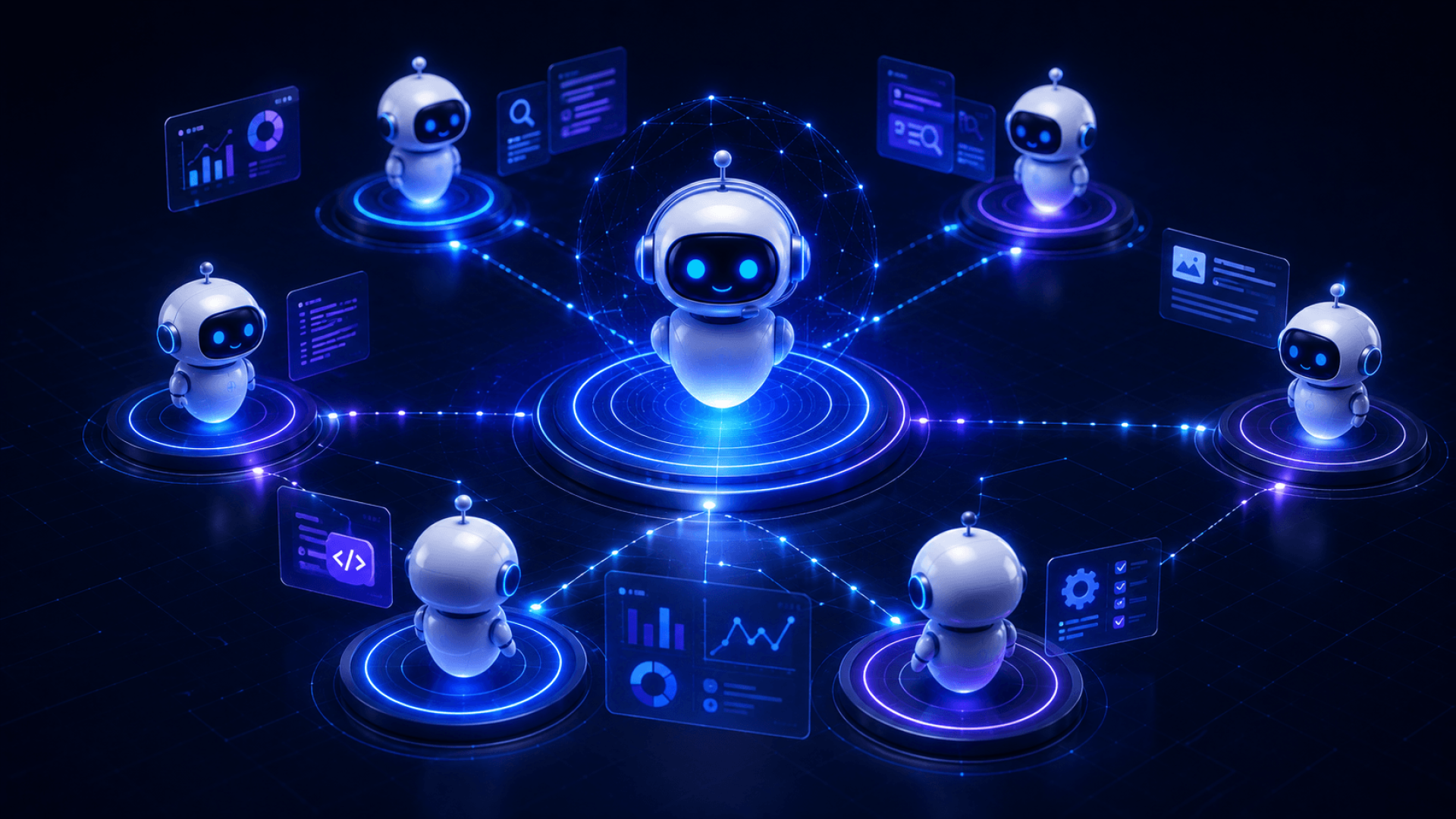
Most production systems use an orchestrator-worker pattern: a lead agent parses the request, plans the workflow, and spawns worker agents to execute subtasks in parallel.

Workers return results to the lead agent, who evaluates completeness and determines whether additional passes are required.

The lead agent enforces task boundaries for each worker, preventing duplication and coverage gaps.

Anthropic found that vague instructions caused workers to repeat searches. As a result, clear handoffs became a core rule (Anthropic, 2025).

Agents require protocols for inter-agent communication and tool integration. Two open standards address this need.

The Model Context Protocol (MCP) links agents to tools and data. Agent-to-Agent (A2A) protocols allow agents to pass work to one another.

For a closer look at how agents call tools and pass data, see our guide to tool calling in AI agents.

The Four Architecture Patterns

Multi-agent architectures are based on a few coordination patterns. Most production systems combine two or three, selected for the necessary control, speed, and fault tolerance.

Orchestrator-worker (hub-and-spoke): a central lead agent delegates to worker agents and aggregates their outputs. This is the dominant pattern in production deployments.

Strengths: strong control, straightforward debugging. Ceiling: the lead agent can become a bottleneck under high load.

Hierarchical: A manager agent delegates to sub-managers, who then delegate to specialists. This pattern suits large, multi-team tasks and scales well, but additional layers increase latency.

Sequential (pipeline): agents execute in a fixed order, each handling a stage and passing results downstream.

Example: one agent gathers data, the next formats, and the next validates. Simplicity is the strength; the ceiling is that early errors propagate through the pipeline.

Decentralised (mesh): Agents communicate directly and self-organise without a central lead. Strengths include fault tolerance and flexibility. Limitation: this pattern is the most difficult to debug and control.

Our AI agent architecture guide shows how to combine these patterns for a real workload.

Where Multi-Agent Systems Win, and Where They Fail

Benchmarks reveal both benefits and risks. Successful teams recognize and manage both aspects of the trade-off.

The benefits are tangible. Anthropic's multi-agent research system used one lead agent and several subagents.

It outperformed the best single-agent setup by 90.2% on an internal research test (Anthropic, 2025). Running subagents in parallel also reduced research time by up to 90% on complex queries.

The primary reason is that multi-agent systems allocate more tokens to a problem, distributed across separate context windows. Anthropic found that token usage alone accounted for 80% of the score difference on a challenging benchmark.

However, this increased spending is a significant consideration. According to Anthropic's data, multi-agent systems used about 15 times more tokens than a standard chat. The value of the task must justify the additional cost.

Failure risk is quantifiable. A UC Berkeley team analyzed 1,642 runs across seven multi-agent frameworks.

They found task failure rates ranging from 41% to 86.7% (Cemri et al., 2025). The team categorised 14 failure modes into three groups: design flaws, agents miscommunicating, and insufficient result checking.

Miscommunication between agents is a failure mode unique to multi-agent systems. When tasks are divided, agents may misinterpret each other's output, causing errors to propagate.

The same study demonstrated the effectiveness of mitigation. Adding a single result-checking step increased success on a coding test by 15.6%.

Gartner offers a market warning, predicting that more than 40% of agentic AI projects will be cancelled by the end of 2027.

Key drivers include rising costs, unclear value, and insufficient risk controls (Gartner, 2025). Multi-agent systems are appropriate only when task requirements exceed single-agent capabilities.

Single Agent or Multi-Agent? A Decision Framework

The key decision is whether the task fits within a single agent’s context and workflow or requires parallelism and distributed memory.

Default to the simplest viable pattern. A single, well-configured agent with robust tools can address more production needs than many teams expect. Move to a multi-agent system only when parallelism or specific limitations require it.

Multi-agent systems fit when work is inherently parallel, when source data exceeds a single context window, or when the workflow spans multiple tools and systems. Use cases: research, broad data aggregation, cross-system orchestration.

Single agents are optimal for sequential tasks or those requiring shared context at every step. Most coding workflows fit this category, as steps are interdependent and do not parallelise. Adding agents in these cases increases overhead without benefit.

Want a clearer line between the categories in play? Our comparison of AI agents, chatbots, and copilots sets the definitions straight before you scale to a network.

Multi-Agent Use Cases Across SaaS, Fintech, and HealthTech

Multi-agent systems are cost-effective only in a limited set of high-value scenarios.

In SaaS, multi-agent systems support research features that aggregate data from multiple sources in parallel. A lead agent plans the query.

Subagents collect evidence in parallel, and a final agent validates citations before output. This mirrors the architecture Anthropic used in its research product.

In fintech, agents divide fraud review, document processing, and financial analysis into focused roles that operate concurrently. Each agent remains specialised, making decisions easier to audit, which is important in regulated environments.

In health technology, teams use linked agents to route work across diagnostic support, care management, and administrative tasks. This separation keeps sensitive steps distinct and easier to verify.

To see how agent design maps to real roles, our overview of the types of AI agents shows which agent shapes fit which jobs.

Building Multi-Agent Systems with Cypherox

Building a functional multi-agent system is an engineering task, not a demonstration. Successful teams prioritise coordination, validation, and cost control as core design elements. Most failed projects neglect these areas.

Cypherox develops AI agent systems for SaaS, fintech, and healthtech teams with production requirements and limited internal resources.

We start by assessing whether your workload is best suited to a single agent or requires multi-agent coordination, helping you avoid unnecessary complexity and cost. Explore our AI application development services or hire a dedicated AI developer team to support your roadmap.

Frequently Asked Questions

A multi-agent system is a group of AI agents that team up to handle tasks too large for one agent alone. Each agent has its own role, tools, and memory. Often, one agent leads by organizing the work and assigning smaller tasks to the others, who work together at the same time.
A single agent is one model that uses its tools in a repeated loop. In a multi-agent system, several agents split up the work. Using multiple agents is helpful when tasks can be done at the same time or are too big for one agent. But multi-agent systems usually cost more and can fail more often.
Use a multi-agent system if the work can be done at the same time, if the data is too big for one agent, or if the task needs many different tools. Use a single agent for tasks that need to be done step by step and need shared information, such as most coding jobs.
The four main patterns are orchestrator-worker (also called hub-and-spoke), hierarchical, sequential pipeline, and decentralised mesh. Orchestrator-worker is the most common in practice. Most systems mix two or three patterns to get the right balance of control, speed, and reliability.
A UC Berkeley study of 1,642 runs found failure rates between 41% and 86.7%. Most failures happen because of design issues, agents misunderstanding each other, or not checking results well enough. Agents can misread each other's output, and mistakes can spread, which does not happen with single agents.
Multi-agent systems cost more because they use many more tokens. For example, Anthropic found its multi-agent system used about 15 times more tokens than a regular chat. Because of this, teams only use multi-agent systems for tasks that are worth the extra cost.
Vipinraj Nair

About the Author

Vipinraj Nair LinkedIn

Founder & CEO

Vipinraj Nair is the Founder and CEO of Cypherox Technologies, which he started in 2015. He leads the company's work across custom software, web and mobile development, and AI solutions for startups, SMEs, and enterprises worldwide. He writes on technology trends, custom development, and how businesses put emerging tech to practical use.