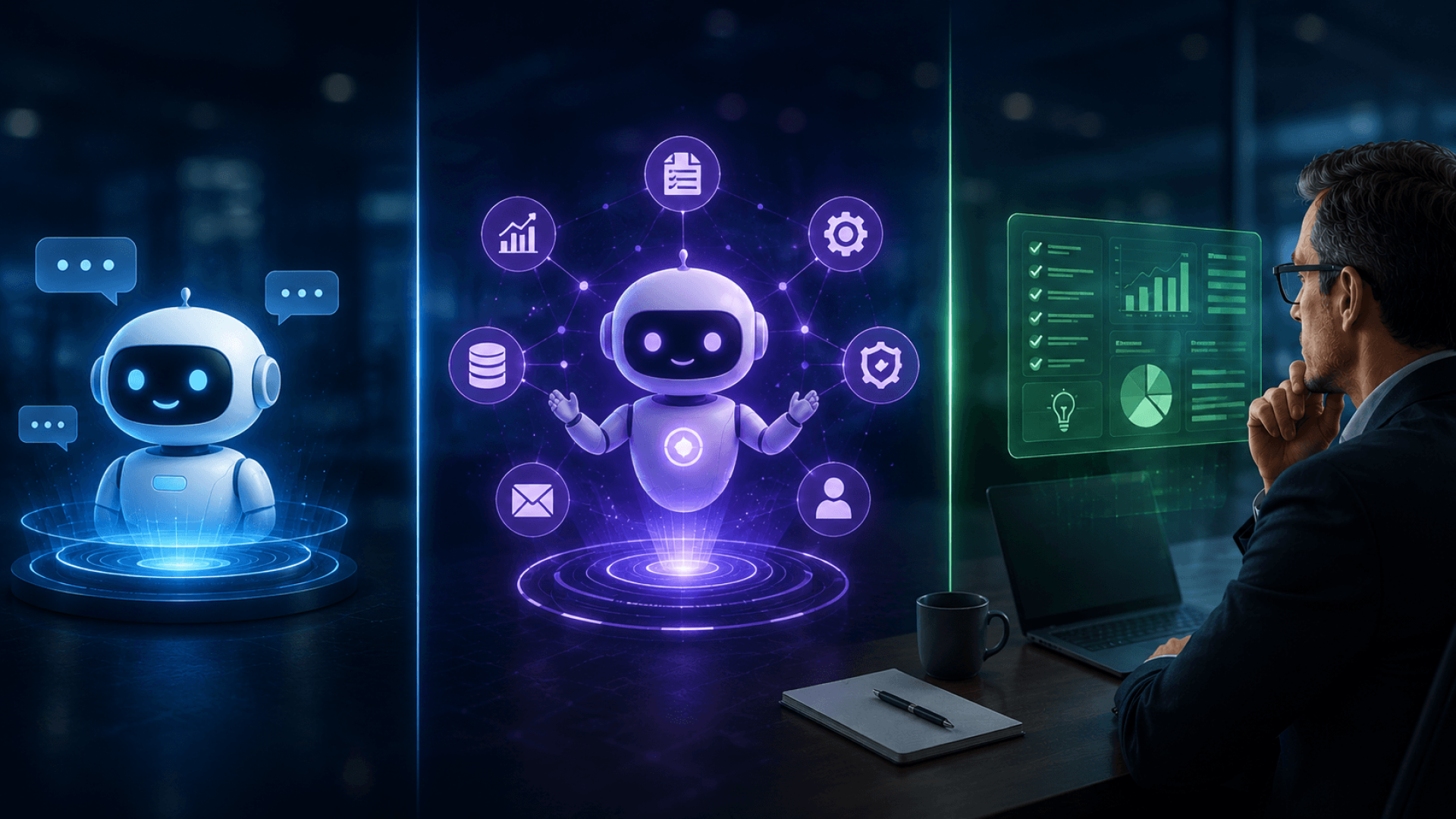
AI Agents vs Chatbots vs Copilots: The Distinction That Changes Your AI Strategy
Quick Summary
Many teams confuse AI agents, chatbots, and copilots, and end up building the wrong system. Chatbots retrieve information fast. Copilots boost productivity. Agents automate workflows at scale. Understand the cost, governance, and risk of each before you commit.
People often use these three terms interchangeably, but confusing them can lead to expensive project failures. Chatbots answer questions, copilots assist users, and agents take action. Each has a different design, level of independence, and risk. Picking the wrong one can leave you with costly software that doesn't solve your actual problem.
This difference matters in practice. It determines whether your AI only responds to users, helps people make decisions, or acts independently. It also shapes the technology you need, how you manage it, and the results you achieve.
The Quick Answer: Architecture, Autonomy, and Risk
Dimension
Chatbot
Copilot
AI Agent
Primary Function
Responds to user queries
Assists human decision-making
Executes tasks autonomously
Autonomy Level
User initiates every exchange
User drives workflow; system suggests
System acts without constant human input
Decision Authority
None;human decides on all actions
Shared;system recommends, human approves
Delegated;system acts, human oversees
Input Dependency
Requires continuous user prompts
Requires context from user and system
Operates based on goals and constraints
Failure Cost
Low;worst case, bad answer
Medium;user acts on wrong suggestion
High;agent acts in wrong direction
Governance Complexity
Low
Medium
High
Infrastructure
NLP, retrieval, basic state
LLM, retrieval, soft guardrails
LLM, tools, memory, strict access controls
The table provides a quick summary, but the business impact extends beyond it. Chatbots are about fast answers. Copilots help people work better. Agents create real change, but that change brings risk.
The Gotcha Nobody Talks About: "Agentic" Doesn't Mean What You Think
Some vendors label their chatbots as 'agentic' or 'agents' just because they can make function calls. But that's not what agentic really means. If a system only gives a single response to a user's request, it's not an agent; it's just a chatbot with more features.
True agency needs two things that most systems miss: acting on its own to reach goals, and remembering what happened across different interactions. Just being able to call an API doesn't make a system an agent. It's only an agent if it can check whether it has met its goal, adjust its approach, and keep working without being told what to do each time.
This confusion leads enterprises to:
Buy "agent" platforms, then implement them as chatbots, wasting the capability layer.
Over-govern systems that don't need enterprise-grade controls, slowing deployment.
Under-govern systems that do, creating serious operational and compliance risk.
The key is to decide what you actually need before you start looking for tools.
Chatbots: Information Retrieval, Not Reasoning
A chatbot is a system trained to respond to user input with relevant, coherent text. Modern chatbots use retrieval-augmented generation (RAG) to fetch context from knowledge bases, then synthesize answers. They do not plan, iterate, or act independently.
How it works:
User inputs a question.
The system retrieves relevant context from a knowledge base.
The system generates and returns an answer.
User evaluates the answer and decides what to do next.
Real use cases:
Customer support automation. The user asks about a return policy, the chatbot retrieves the policy, and answers the question.
Knowledge base search. User searches internal documentation; chatbot returns results with summaries.
FAQ automation. Chatbot answers frequently asked questions without human intervention.
The main benefit is speed. Chatbots cut support costs by quickly answering simple, repeated questions. For example, a financial chatbot can handle thousands of account questions daily. A SaaS chatbot that explains features can lower the number of support tickets.
However, there is a hidden risk: chatbots sometimes give answers that sound correct but are actually wrong. If a chatbot gives bad tax advice or incorrect product information, it can damage trust. This risk is even greater in areas like healthcare, law, or finance, where strict checks are required.
Governance needs are low. Chatbots operate in a limited environment and only provide information; they do not make decisions. The main controls are checking their accuracy and having a way to turn them off if needed.
Copilots: Augmenting Human Judgment
A copilot is a system that works alongside a human to complete a task, providing suggestions, context, and partial automation. The human makes the final decision and executes the action. The copilot assists. It does not decide.
How it works:
Humans begin a task (writing code, analyzing data, drafting a contract).
Copilot observes the task and suggests next steps, generates content, or highlights patterns.
Humans review the suggestion, edit it, and decide whether to use it.
A human executes the action.
Real use cases:
Code generation. A developer writes the intent, GitHub Copilot suggests code completions, and the developer edits and commits.
Document drafting. The marketing team writes a campaign outline, Claude Copilot generates copy variations, and a human selects and refines.
Data analysis. An analyst explores a dataset, Copilot suggests statistical patterns and visualizations, and the analyst validates and reports the findings.
Sales enablement. A sales rep works on a pitch, Copilot retrieves customer context and suggests positioning, and the rep customizes and delivers.
The main advantage is productivity. Copilots help people move from starting from scratch to improving existing work. For example, a developer using a code copilot can release features faster. An analyst with a data copilot can test ideas more quickly. A writer with a draft copilot can finish content with fewer edits.
Copilots also make expertise more accessible. A junior marketer using a content copilot can write copy that matches experienced writers. An analyst with a stats copilot can run analyses that once needed a statistician.
The hidden risk is dependency and skill loss. Teams that rely too much on Copilot suggestions stop building the judgment that Copilot is meant to support. A developer who always uses Copilot suggestions may lose the ability to design code independently. An analyst who trusts Copilot-generated correlations without checking can miss important insights.
Another risk is complacency. Copilots sound confident and fluent, which can make mistakes seem reasonable. For example, a financial analyst using a copilot to forecast revenue without checking assumptions takes on extra risk.
Governance needs are moderate. Copilots need quality monitoring, accuracy checks, and clear rules for when a human should step in. They do not need strict access controls because humans still make the final decisions.
AI Agents: Autonomous Execution and Operational Risk
An AI agent is a system that perceives its environment, sets goals, plans actions to achieve those goals, executes those actions, and monitors whether its objectives are met. It operates with delegated authority and a persistent state. The human sets constraints and oversight; the agent operates within them.
How it works:
A human or system event defines an objective.
The agent assesses its current state and available tools.
The agent plans a sequence of actions to achieve an objective.
The agent executes actions, observes outcomes, and adjusts its plan.
The agent reports results and waits for new objectives or constraints.
Real use cases:
IT operations. An agent monitors infrastructure health, detects issues, investigates root causes, escalates to a human if it exceeds its authority, or remediates if authorized.
Financial operations. An agent processes vendor invoices, validates line items against contracts, flags discrepancies, and approves payment if within policy.
HR workflow automation. An agent ingests offer requests, populates employment systems, schedules onboarding, and coordinates with equipment provisioning.
Customer support triage. An agent receives support tickets, classifies severity, gathers context, attempts resolution, and routes to a specialist if needed.
Sales research. An agent identifies high-value prospects, researches company news and financials, identifies buying signals, and proposes outreach timing.
The main advantage is the ability to automate at scale. Agents remove the need for human involvement in repetitive, well-defined workflows. For example, a financial operations agent can process thousands of invoices each week. An IT operations agent can fix infrastructure issues faster and more consistently than people.
Another advantage is compound learning. Agents observe outcomes, adjust their strategies, and improve over time. This is what sets agentic systems apart from traditional RPA: they learn from exceptions and adapt.
A hidden risk is authority creep and miscalibration. For example, an agent allowed to approve vendor invoices up to $10,000 might approve a misconfigured invoice for $9,999. An agent that can escalate support tickets might send a customer the wrong technical solution before a human can step in. Agents can spend money, allocate resources, or contact customers in unexpected ways.
A bigger risk is assuming that goals are always clear. Many business objectives are vague. For example, an agent told to "improve customer satisfaction" without limits might refund money too freely or overstaff support. An agent told to "optimize system cost" might turn off important backups.
A third risk is large-scale hallucination. If a chatbot makes up an answer, a user usually spots the mistake. But if an agent acts on a false belief, it can spread the error across many tools and then give a convincing explanation for what happened.
Governance needs are high. Agents need strict controls: clear limits on objectives, restricted access to tools, operator approval for important actions, ongoing monitoring, and audit trails for every decision. These controls are essential.
When to Use Each: The Decision Framework
Use a chatbot when:
Users need fast answers to frequent questions.
The domain is information retrieval, not decision-making.
Accuracy is important, but errors are low-cost (users notice and correct them).
You need to reduce support costs for repetitive queries.
Your knowledge base is well maintained and up to date.
Customer support, knowledge base search, FAQ automation, and FAQ chatbots are chatbot territory.
Use a copilot when:
You want to accelerate human productivity on cognitively complex tasks.
Humans make final decisions and execute actions.
You want to democratize expertise or reduce time-to-output.
Errors are caught before action (human review step).
The task involves creativity, judgment, or synthesis.
Code generation, content drafting, data analysis support, and research assistance are Copilot territory.
Use an agent when:
You need to automate end-to-end workflows with minimal human touch.
The task is well-bounded, and the success criteria are clear.
Speed and consistency matter more than flexibility.
You can implement strict governance and access controls.
High-frequency execution justifies the infrastructure investment.
Invoice processing, IT operations, HR workflow automation, and customer triage are in the agent's territory. The common thread: bounded, repetitive, high-volume, and low-ambiguity processes.
The Hybrid Approach: What Enterprise Leaders Actually Deploy
Most enterprises do not use one. They use all three in different places.
A SaaS company might deploy:
A chatbot for customer support (to reduce ticket volume).
A copilot for sales teams (accelerates proposal writing and discovery).
Agents for internal operations (to automate invoice processing and infrastructure monitoring).
A financial services firm might deploy the following:
A chatbot for account information (reduce call center volume).
A copilot for credit analysis (suggest relevant comparables and research).
Agents for regulatory compliance (monitor transactions, flag anomalies, route to analyst).
A healthcare provider might deploy the following:
A chatbot for appointment scheduling and patient FAQs.
A copilot for clinical documentation and research assistance.
An agent for insurance authorization workflows.
The rule is to use the least autonomous system that solves your problem. If a chatbot is enough, use it. If you need human judgment, add a copilot. If you need scale and automation, choose an agent, but only with strong governance.
Evaluating Systems: What to Ask Vendors
When a vendor claims their product is an "agent," ask:
Does it act autonomously, or does it wait for user input after each step? If it responds to a user query and returns a result, it's a copilot or chatbot with function calling. Agents iterate toward goals without step-by-step user prompting.
Can it maintain state and adjust strategy across interactions? If it resets context between interactions, it's not an agent. It's a stateless chatbot. Agents remember objectives, learn from outcomes, and adjust.
What access controls and approval gates are built in? If the answer is "you implement those in your wrapper," the system is not agent-ready. Enterprise agents require fine-grained access controls, escalation paths, and audit trails built into the core.
What happens when the agent's goal conflicts with constraints? Legitimate agents have well-defined fallback behavior. They escalate when they reach authority boundaries. They do not guess.
How is hallucination prevented in action? Chatbots hallucinate in text. Agents hallucinate in action. The questions to ask: Does the system verify tool outputs before acting on them? Does it cross-reference information across sources? Does it have confidence scoring?
The Cost and Timeline Trap
Building custom agents is more expensive and slower than deploying chatbots or copilots.
Copilot: 4-8 weeks, $50K–$150K, medium governance. Build integrations, define quality thresholds, and train users.
Agent: 8-16 weeks, $150K–$500K+, high governance. Governance design, access control architecture, extensive testing, compliance review. This is before you hit production edge cases.
Enterprises often underestimate the complexity of agents, confusing agent-ready frameworks with real production agents. Tools like LangGraph or CrewAI let you build a prototype in a few days. But turning that into a production system with governance, monitoring, compliance, and safety measures takes months.
The hidden cost is in iteration. Chatbots and copilots fail in ways that are easy to catch. If a chatbot gives wrong information, a user notices. If a copilot suggests bad code, a developer spots it. But if an agent misunderstands its goal, it can make many wrong decisions before anyone notices.
The Governance and Risk Profile: What Actually Changes
Chatbots: Governance is output monitoring. Does the chatbot answer accurately? Is hallucination within acceptable bounds? Are users satisfied? Remediation is simple: improve the knowledge base or retrieval system.
Copilots: Governance is quality assurance plus user training. Is the copilot generating accurate, useful suggestions? Are users relying on it appropriately or becoming overly dependent? Remediation involves retraining or refining suggestion logic.
Agents: Governance is comprehensive. Authority and escalation rules (What can the agent do without asking?). Access controls (What systems and data can it touch?). Monitoring and observability (Can you see what it did and why?). Approval workflows (When do humans review before action?). Audit and compliance (Can you prove what it did for regulatory purposes?). Incident response (What happens when the agent makes a wrong decision?).
These controls are not optional for enterprise agents. If a chatbot makes up an answer, it just creates a support ticket. But if an agent misinterprets a financial transaction, it can lead to a compliance issue.
Real Production Edge Cases
The Chatbot Edge Case: A chatbot trained on 2024 market data gives outdated pricing information to a customer. The customer complains. The issue is knowledge base freshness and retraining lag. Fix: retrain on 2025 data.
The Copilot Edge Case: A code copilot suggests a library with a known security vulnerability, and a developer uses it without checking. The vulnerability reaches production. The issue is user judgment failure and Copilot accuracy. Fix: security scanning, user education, Copilot fine-tuning.
The Agent Edge Case: An agent authorized to approve vendor invoices up to $50,000 receives a request for $49,999. The vendor is legitimate, but the invoice includes a duplicate line item. The agent doesn't catch it and approves. The money is spent. The issue is that the agent didn't validate line-item accuracy before approval. Fix: add a validation step, but accept that the agent will be slower and more costly.
The pattern is clear: as systems become more autonomous, the cost of failure rises sharply. That's why governance is so important.
How Cypherox Approaches Agentic Systems
At Cypherox, we build custom AI-powered solutions for enterprise teams because off-the-shelf agent platforms rarely account for the full complexity of enterprise integration, governance, and risk.
Our approach:
1. Use-case clarity first. We start by determining whether you need a chatbot, a copilot, or an agent. Many teams assume "agent" because it sounds advanced. We assess your actual workflow, volume, and decision authority.
2. Architecture matching. A chatbot needs good retrieval. A copilot needs good integration and context management. An agent needs governance, monitoring, and strict access controls. We design infrastructure that matches the task at hand.
3. Governance by design. For agentic systems, we embed controls into the architecture: escalation rules, approval gates, audit logging, and monitoring. This is not added later; it's built in.
4. Testing and validation. Agents require extensive edge-case testing before production. We run scenario testing, failure mode analysis, and governance audits before handoff.
5. Production support. We establish monitoring, alerting, and incident response before go-live. When edge cases happen, we have the infrastructure to detect and respond quickly.
When rolling out AI solutions at enterprise scale, governance is what separates a working prototype from a reliable production system. Most projects get stuck at this stage.
Next Steps: Building Your AI Strategy
Choosing between a chatbot, a copilot, or an agent shapes your entire deployment strategy. Picking the wrong one can set you back months, while picking the right one adds value over time.
If you are building automation for customers, start with a chatbot. It's quick, low-risk, and helps you learn about your domain. When you reach its limits and need to perform tasks, not just answer questions, move up to agents.
If you are creating productivity tools for your team, start with a copilot. It supports your top people, shows where humans and AI work well together, and helps your team get used to AI integration.
If you're automating internal operations, evaluate agents, but invest heavily in governance. The ROI is real, but the risk is higher. Start with well-bounded workflows, not critical systems.
For enterprises building custom agents, the path is: define the use case, design the governance model, choose or build the architecture, test extensively, deploy with monitoring, and iterate based on edge cases.
The teams that succeed with agentic AI are not those with the most advanced models. They are the ones with clear use cases, strong governance, and the discipline to test thoroughly before scaling up.
About the Author
Vipinraj Nair
Founder & CEO
Vipinraj Nair is the Founder and CEO of Cypherox Technologies, which he started in 2015. He leads the company's work across custom software, web and mobile development, and AI solutions for startups, SMEs, and enterprises worldwide. He writes on technology trends, custom development, and how businesses put emerging tech to practical use.