Production-Ready Multi-Agent Systems: Fault Tolerance, State Management, and Cost Control
Most multi-agent demos work. A planner hands work to three specialists, a reviewer checks the result, and the output looks impressive. The trouble starts when the same system meets real traffic. An API times out on step nine of fourteen, the reviewer rejects a draft for the fifth time in a row, or a deploy restarts the container halfway through a refund.
None of these are model problems. They are distributed systems problems, and teams that treat them that way are the ones whose agent programmes survive budget review. Gartner expects more than 40% of agentic AI projects to be cancelled by the end of 2027 because of escalating costs and unclear business value. Rising cost and weak risk controls are engineering outcomes before they are business outcomes.
This guide is for CTOs, VPs of Engineering and platform leads who already have a working multi-agent prototype and need it to behave like production software. It covers how these systems fail, the architecture that contains those failures, and the specific controls for state, retries, loops, cost, tracing and security. It also covers the framework decision now facing every enterprise team in 2026.
First, Confirm the Workload Needs More Than One Agent
Multi-agent architectures buy capability with tokens. Anthropic's engineering team reported that agents typically use about 4× more tokens than chat interactions, and multi-agent systems use about 15× more tokens than chats. They also found that token usage explained about 80 percent of performance differences in their internal testing.
That trade is worth making when work splits into independent, parallel threads, such as broad research, multi-source data gathering or cross-system reconciliation. It is rarely worth making when every step depends on shared context, which describes most coding and transactional workflows.
If you haven't settled that question yet, our explainer on when a multi-agent design is worth the cost walks you through the decision. Everything below assumes you have settled it and need the system to run reliably.
How Multi-Agent Systems Actually Fail
The most useful evidence comes from UC Berkeley's MAST study. The researchers built an empirically derived taxonomy of 14 multi-agent system failure modes and a dataset of 1642 annotated execution traces drawn from seven popular frameworks. They grouped the failures into 3 categories: (i) specification issues, (ii) inter-agent misalignment, and (iii) task verification.
Their key takeaway for engineering leaders is that these failures often stem from system design issues, not just LLM limitations. A stronger model narrows the failure rate. It does not remove failures caused by how agents are wired together.
The table below translates each category into what it looks like in a running system and the control that addresses it. The final row covers failures that benchmark studies don't capture but production always does.
Failure category
What it looks like in production
Engineering control
Specification and system design
Agents step outside their role, repeat completed work, or run without a clear stopping point
Typed handoff contracts per agent, progress tracked in explicit state fields, termination conditions written in code
Inter-agent misalignment
An agent proceeds on a wrong assumption, drops information from a handoff, or restarts a thread of reasoning
Schema-validated messages between agents, shared state as the single source of truth instead of chat history, an explicit clarification path
Task verification and termination
The system stops early, or accepts output nobody actually checked
An independent verifier step, deterministic checks wherever the answer is checkable, and verification as a gate before any side effect
Infrastructure and operations (outside MAST)
Timeouts, 429 rate limits, crashes mid-run, duplicate side effects after retries, runaway spend
A Reference Architecture: Treat the Agent Team as a Distributed System
One principle drives everything else: models propose, deterministic code disposes. Nondeterministic reasoning should never directly mutate a system of record. It produces a structured proposal, and your code validates, authorizes, and executes it.
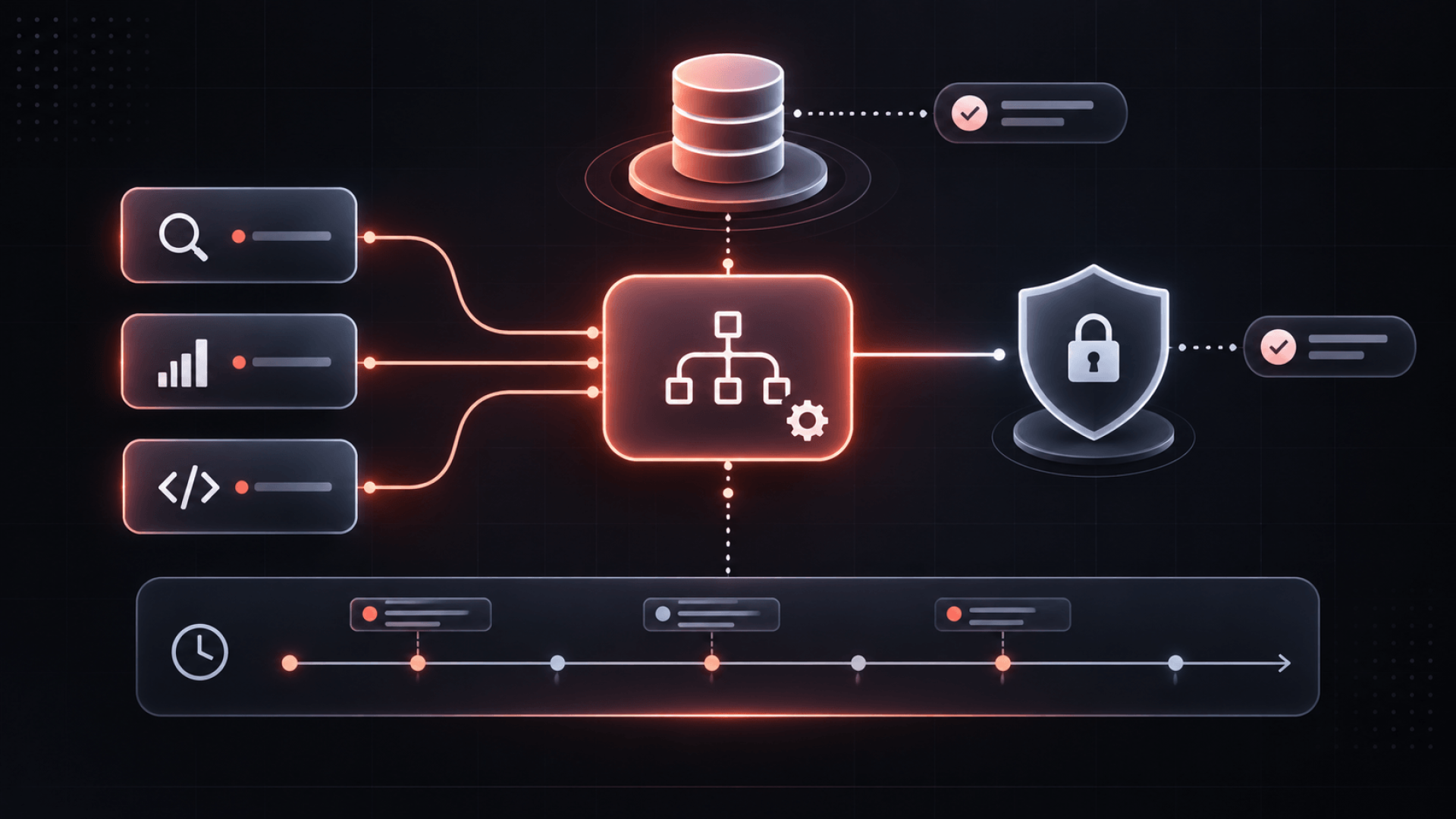
In practice, a production multi-agent system has seven layers:
Telemetry pipeline (OpenTelemetry traces + metrics) and dead-letter queue (replay)
A few points in that diagram matter more than they look:
The run API is asynchronous. Agent runs take seconds to days, so clients get a run ID and poll or subscribe for updates. Synchronous chains of agent calls are where timeouts and dropped connections start.
The model gateway is shared. Routing, rate limiting, token accounting and provider failover live in one place rather than inside each agent.
The side-effect gateway is the only path to write. Every refund, email, or record update goes through it, giving you one place to enforce idempotency, policy checks, and audit logging.
For the single-agent building blocks underneath this, such as routing, orchestrator-workers and evaluator loops, see our guide to core agent architecture patterns.
State Management and Durable Execution
Prototype agents keep state in memory and in the conversation transcript. Production agents cannot, because processes crash, pods get rescheduled and approvals arrive three days later.
How checkpointing works in LangGraph
In LangGraph, a checkpointer saves a snapshot of graph state at each super-step, organized into threads. Each run gets a thread_id, and that ID is the handle for resuming, inspecting or replaying the run.
LangGraph also handles partial failures within a step. When one node fails, LangGraph stores pending checkpoint writes from any other nodes that completed successfully at that super-step, so those nodes are not re-run when you resume.
You choose how aggressively the state persists. In "async" mode, LangGraph persists changes while the next step executes, with a small risk that a crash loses a checkpoint. In "sync" mode, it persists changes before the next step starts, trading some performance for durability. A third mode, "exit", only saves when the run ends. Use "sync" for any workflow that touches money, customer records or regulated data.
The replay trap
The detail that catches most teams is how resumption works. When you resume a workflow run, the code does NOT resume from the same line where execution stopped. It replays all steps from an appropriate starting point, typically the beginning of the interrupted node.
Any side effect inside that node can therefore run twice. The documentation is explicit that durable workflows should be deterministic and idempotent, with side effects and non-deterministic operations wrapped inside tasks.
Durable state in Microsoft Agent Framework
Microsoft Agent Framework takes a similar approach at the workflow level. Its checkpointing and hydration ensure long-running processes survive interruptions. A workflow can pause on a high-risk action and wait hours or days for an approval arriving through a separate channel before continuing.
Three rules for state design
These apply whichever framework you use:
Keep the checkpointed state small. Store documents, retrieved chunks and large tool outputs in object storage and keep references in state. Separating document storage from the graph state store prevents checkpoint bloat and token-heavy payload transfers across execution cycles.
Version your state schema. A run that started under v3 of your graph may resume after v4 deploys. Treat state like a database schema with explicit migrations.
Separate run state from long-term memory. The checkpoint tracks one run. Customer preferences and learned facts belong in a separate store with its own retention and access rules.
Fault Tolerance: Retries, Idempotency, Loop Limits and Dead Letters
Not every error deserves a retry. Agentic workflow error recovery starts with classifying the failure, because each class needs a different response.
Error class
Example
Correct response
Transient
Network timeout, provider 5xx
Retry with exponential backoff and jitter
Rate limit
HTTP 429 during parallel fan-out
Back off, and cap concurrency at the gateway
Semantic
Malformed JSON, schema violation, missing field
One repair attempt with the validation error fed back, then escalate
Logic loop
Reviewer rejects the same draft repeatedly
Counted attempts with a coded exit to a fallback path
Terminal
Policy denial, budget exhausted, retries spent
Dead-letter the run with its thread ID for inspection and replay
Rate limits under fan-out
Rate limits deserve special attention in multi-agent designs. Fan-out multiplies throughput: parallel fan-out patterns multiply token throughput by the branch factor. Five parallel researchers can trip a limit that a single agent never would. A concurrency limiter at the model gateway prevents this better than any retry policy.
Never rely on a framework's default loop limit.
LangGraph's recursion_limit is a last-resort safety net, not a loop-control mechanism, and published defaults vary by version. Older guides cite a default of 25 steps, while one hands-on test of v1.2 reported a default of 10007 steps. At that default, an LLM-backed loop could burn through thousands of calls before it halts.
Set the limit explicitly on every run. Keep your own attempt counter in state, well below it.
A worked example in LangGraph
The example below shows these controls together in a refund-resolution workflow. A drafting agent proposes a resolution, a review agent checks it, a human approves anything that moves money, and the refund executes exactly once.
resolution_agent, review_agent, payments and dlq stand in for your own components. Parameter names reflect LangGraph 1.x; confirm them against the version you pin.
Four design choices in that code do the real work:
Rejections carry their reason forward. The reviewer's notes go into the next draft, because a retry without the rejection reason just reproduces the same failure.
The idempotency key is deterministic. It is derived from the run and business identifiers, so a replay after a crash cannot issue a second refund.
The approval node has no side effects before interrupt(). It is safe to re-run on resume.
Exhausted runs are dead-lettered, not dropped. The dead-letter record holds the thread ID, so an engineer can inspect the checkpoint history, fix the cause and resume the same run instead of starting over.
Two operational additions
A circuit breaker belongs at the model gateway. When a provider's error rate crosses a threshold, stop sending traffic for a cool-down window and fail over to a secondary model rather than letting every agent retry into an outage.
Deploys need graceful draining too. LangGraph 1.2 added a drain signal that lets a run stop at the next superstep boundary instead of dying mid-node during a rollout.
For tool-level controls, such as schema design, argument validation and error contracts the model can act on, see our guide to tool schema and idempotency design.
Cost Control for Agent Teams
Generic LLM agent cost optimization advice, like caching and smaller models, still applies. Multi-agent systems add a problem single agents don't have: spend multiplies across agents that cannot see each other's consumption.
Five controls address that directly:
Give each run a budget ledger. Carry tokens_used (or dollar cost) in run state, charge every agent against it, and route to a fallback or dead-letter path when it runs out. Subagents should receive a slice of the remaining budget, not an unlimited allowance.
Cap fan-out. Set a maximum number of parallel workers per run and per tenant. Without a cap, a planner that decides one query needs twenty researchers will spend accordingly.
Tier models by role. Anthropic's research system paired Claude Opus 4 as the lead agent with Claude Sonnet 4 subagents. The same principle applies broadly: reserve the most capable model for planning and synthesis, and use cheaper models for extraction, classification and verification checks.
Compress handoffs. Workers should return condensed, structured findings to the orchestrator, not raw transcripts. Every token a worker passes upward is billed again on every later orchestrator call.
Measure cost per successful outcome. Cost per call hides failed and retried runs. Divide total spend by runs that completed and passed verification. This is the number your CFO will eventually ask for, and the number that shows whether a design change actually helped.
Observability: Tracing Agent Teams with OpenTelemetry
You cannot debug a multi-agent run from application logs. You need a trace showing which agent did what, in what order, with which tools, at what cost.
The industry is converging on OpenTelemetry's GenAI semantic conventions for this. They define standard span types including create_agent and invoke_agent for an agent run, and invoke_workflow for an orchestrated multi-step process. Alongside them sit metrics such as gen_ai.invoke_agent.duration for full agent run duration, and gen_ai.invoke_agent.tool_calls for how many tool calls an agent run made.
Using a shared standard means your traces read the same in Datadog, Grafana, Langfuse or any other OTel-compatible backend. It also makes vendor changes cheap.
Two caveats before you instrument
First, the conventions are still moving. In June 2026, with v1.42.0, the conventions moved into a dedicated semantic-conventions-genai repository so they could iterate faster, and they remain in development status. Pin the version you instrument against, and budget time to update it.
Second, be deliberate about content capture. Prompt and completion text can contain personal or regulated data. The conventions treat content capture as opt-in. A sensible production default is to record token counts, model names, tool names and outcomes on spans, and store full content separately under the same access controls as the underlying data.
Turn traces into evaluations.
Traces become far more valuable once you evaluate them. The MAST team released a validated LLM-as-a-Judge pipeline integrated with MAST, which can label sampled production traces by failure mode. Alerting on a rising rate of verification failures or inter-agent misalignment catches quality regressions that error-rate dashboards miss entirely.
Security and Governance Between Agents
Multi-agent systems inherit every single-agent risk and add new ones at agent boundaries. The OWASP Top 10 for Agentic Applications 2026, developed with more than 100 industry experts and published in December 2025, covers risks including tool use, identity, memory, inter-agent communication, cascading failures, and rogue agents.
The controls that matter most for agent teams:
Give every agent its own identity and scoped credentials. A research agent should not hold the payment agent's API key. When one agent is compromised through injected content, scoping limits the blast radius.
Treat messages between agents as untrusted input. One agent's output becomes another's context. Validate handoffs against a schema, and never let free text from a worker become an instruction to an agent with write access.
Contain cascades. Per-agent circuit breakers, budget limits and a tested kill switch for the whole run stop one misbehaving agent from dragging the others with it.
Use a management framework around the technical controls. In the US, the NIST AI Risk Management Framework is the common governance loop for identifying, measuring, and treating these risks. The OWASP list supplies the concrete risk categories that sit inside that loop.
Choosing a Framework in 2026: LangGraph, Microsoft Agent Framework and the AutoGen Question
The framework landscape shifted significantly in the past year, and many enterprise prototypes are built on a framework that is no longer moving forward.
AutoGen entered maintenance mode in October 2025, with bug and security fixes only and no new features. Microsoft now recommends its successor for new work. On April 3, 2026, Microsoft shipped Agent Framework 1.0 for .NET and Python, which is the unified successor to both Semantic Kernel and AutoGen. It includes sequential, concurrent, handoff, group chat and Magentic-One orchestration patterns, all with support for streaming, checkpointing and human-in-the-loop.
LangGraph
Microsoft Agent Framework
AutoGen
Status
Actively developed (1.x)
1.0 GA since April 2026
Maintenance mode since October 2025
Languages
Python, TypeScript
Python, .NET
Python, .NET
Durable state
Checkpointer per super-step, three durability modes
Workflow checkpointing and hydration
Not recommended for new durable workloads
Human-in-the-loop
interrupt() with Command(resume=...)
Pause and resume on external approval
Available, but frozen
Best fit
Teams wanting low-level control of graph and state in Python or TypeScript
.NET or Azure-centric enterprises, and teams consolidating Semantic Kernel or AutoGen code
Existing code only, with a migration plan
How to decide
Choose LangGraph when your engineering stack is Python or TypeScript and your team wants explicit control over state, persistence and graph topology.
Choose Microsoft Agent Framework when your organization runs on .NET and Azure, or when you are consolidating existing Semantic Kernel or AutoGen code.
If you are running AutoGen in production today, there's no need to panic. You do need a decision:
Freeze new features on AutoGen.
Wrap it behind the same run API, side-effect gateway and telemetry described above, so the framework becomes replaceable.
Plan the migration while the system is still small enough to move.
The architecture in this article is deliberately framework-neutral, which is what makes that migration manageable.
A Production Readiness Sequence
When a multi-agent prototype is heading for production, this order of work avoids most expensive surprises:
Re-validate the decision to use multiple agents. Confirm the workload is genuinely parallel and the value per task justifies the token multiple.
Separate reasoning from side effects. Route every write through a side-effect gateway with idempotency keys and policy checks before anything else changes.
Add durable checkpoints. Use synchronous durability on any path that touches money, customers or regulated data.
Put explicit limits on every loop and run. That means attempt counters, recursion limits, fan-out caps and a per-run budget, each with a coded exit path.
Instrument with OpenTelemetry GenAI spans before scaling traffic. Add cost per successful outcome as a headline metric.
Build a verification gate and an evaluation set. Score sampled production traces against it weekly.
Run a security review of agent identities, credentials and inter-agent message handling. Use the OWASP agentic list as the checklist.
Load-test with failure injection. Kill pods mid-run, return 429s, corrupt a tool response, and confirm the system resumes, retries or dead-letters as designed.
The organizations getting value from multi-agent systems are not the ones with the cleverest prompts. They decided early that agents are components in a distributed system, and gave them the same treatment as any other production service: durable state, idempotent writes, bounded retries, budgets, traces and least-privilege access.
That work is less visible than a demo, but it determines whether the system survives real traffic, real failures, and a quarterly cost review.
If your team has a multi-agent prototype that works in testing but stalls on reliability, cost, or approval, Cypherox can help. We review the architecture, identify the failure points, and build the production layer around it. Explore our AI agent development services, or talk to our engineering team about your system.
Frequently Asked Questions
Is AutoGen still maintained in 2026?
AutoGen is in maintenance mode, receiving bug and security fixes but no new features. Microsoft recommends Microsoft Agent Framework, which reached 1.0 general availability in April 2026, for new projects. A community fork, AG2, also continues independently. Teams running AutoGen in production should plan a migration rather than expand on it.
Should we use LangGraph or Microsoft Agent Framework?
Both support durable checkpointing and human-in-the-loop approvals, so the decision usually follows your stack. LangGraph suits Python and TypeScript teams that want explicit control of graph state and persistence. Microsoft Agent Framework suits .NET and Azure environments and teams consolidating Semantic Kernel or AutoGen code.
How do you stop agents getting stuck in infinite loops?
Track attempts in state and route to a fallback or dead-letter path when you reach a limit, rather than relying on the framework's recursion limit. Pass the reason for each rejection into the next attempt so retries change something. Combine this with a per-run token budget so a loop is stopped by cost even if the counter logic has a bug.
Why do retries cause duplicate actions in agent workflows?
Durable frameworks resume by replaying the interrupted step, and retry policies re-run failed steps. Any side effect inside that step, such as a payment or an email, can execute twice. The fix is to route side effects through code that sends a deterministic idempotency key, so the downstream system recognizes and ignores the repeat.
About the Author
Vipinraj Nair
CEO & Founder
Vipinraj Nair is the Founder and CEO of Cypherox Technologies, which he started in 2015. He leads the company's work across custom software, web and mobile development, and AI solutions for startups, SMEs, and enterprises worldwide. He writes on technology trends, custom development, and how businesses put emerging tech to practical use.