
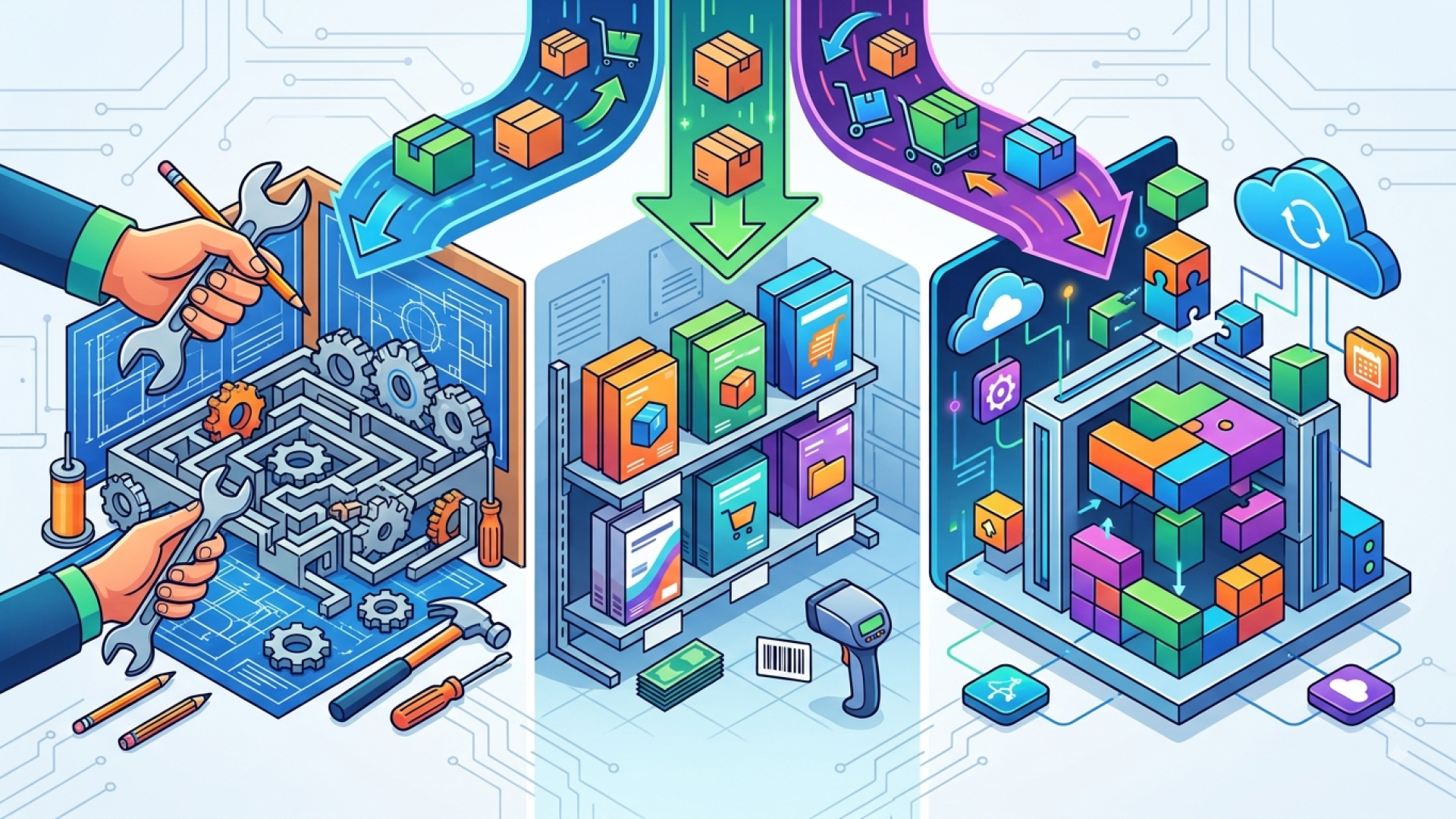
A custom order management system automates order capture, inventory checks, routing, and fulfillment according to your specific workflows, not a vendor’s template. While tools like Shopify or BigCommerce are effective for standard orders, they commonly struggle with additional channels, higher volumes, or complex integrations. Custom systems overcome these limitations but require more development time and significant engineering commitment.
Key Takeaways
- Global spending on order management system software is projected to reach $1.9 billion in 2026, up from $1.0 billion in 2021, a 12.8% five-year compound annual growth rate, according to Forrester.
- Retailers with three or more sales channels see much higher engagement than those with just one. A major Harvard Business Review study of 46,000 shoppers found that 73% shop across multiple channels instead of sticking to only one.
- Poor inventory synchronization is a serious problem. IHL Group estimates that global inventory distortion, the combined cost of overstock and stockouts, costs $1.77 trillion each year.
- Integration complexity is often the most underestimated cost in enterprise software projects. A study by McKinsey and the University of Oxford, of 5,400 IT projects found that 66% went over budget, and each extra year added about 15% more to the overrun.
- The decision is not all-or-nothing. Many companies use a platform tool for standard orders and add a custom layer for workflows the platform cannot support.
What Is a Custom Order Management System?
A custom order management system is designed to capture, validate, route, and track orders across all sales channels, using your specific business rules, integrations, and exception logic. Unlike platform apps or no-code tools, you own and control the system rather than licensing a fixed set of features. This ensures your system can scale as order volume, channel count, and complexity increase.
OMS vs ERP: What Each Handles
Order management systems and enterprise resource planning systems address different needs. The OMS manages the order lifecycle, including capture, validation, routing, and tracking. The ERP oversees core business functions such as accounting, financial reporting, procurement, and sometimes manufacturing. Order data typically flows into the ERP, but the ERP does not manage the order process.
OMS vs WMS: Scope and Boundaries
A warehouse management system manages warehouse operations such as receiving, storing, picking, packing, and inventory counting. An OMS operates at a higher level, determining which warehouse or fulfillment center should process each order. Companies with multiple fulfillment locations typically require both systems to communicate in real time.
Why "Order Management" Matters More Than "System"
The orchestration logic is the most important aspect of an OMS, not the user interface. While a spreadsheet may suffice for a small number of daily orders, increased order volume and channels strain the decision logic, such as order routing, exception handling, and inventory allocation, rather than the data entry process.
When Platform OMS Solutions Hit Their Limit
Platform OMS tools are built for standard use cases and perform well until your order volume, channel count, or business rules exceed their capabilities. At that point, teams develop workarounds outside the platform, reintroducing manual processes the platform was intended to remove. As a result, engineers spend time addressing platform limitations rather than improving the system.
Multi-Channel Orders Break Platform Logic
Platform apps are designed for orders from a limited number of predictable sources. If your business sells via multiple channels, such as your website, marketplaces, B2B portals, and sales teams, consolidating these orders into a unified inventory view often requires custom coding beyond most platforms’ capabilities.
Custom Fulfillment Rules Require Workarounds
Split shipments, partial fulfillment, backorders, and multi-warehouse routing are common in larger businesses. However, most platform apps support only a single fixed fulfillment path, requiring teams to manually manage exceptions that should be automated.
Inventory Systems Don't Talk to Your Platforms
According to IHL Group, inventory distortion, including overstock and stockouts, costs $1.77 trillion globally each year. This is largely due to slow inventory data updates between the storefront, warehouse system, and ERP, rather than real-time synchronization.
Order Exceptions Consume More Time Than Standard Orders
A single failed payment, address mismatch, or inventory conflict can require more manual support time than processing many standard orders. Most platform apps lack flexible, rules-based exception handling, resulting in unnecessary manual work.
Your Teams Spend More Time Finding Information Than Acting on It
When order status, inventory, and fulfillment details are stored in separate systems, answering customer questions requires checking each system. This additional effort increases with order volume, even if resolution time per order remains constant.
Scaling Requires Increasingly Complex Mappings
Each new sales channel, warehouse, or fulfillment partner increases complexity for a platform app. Eventually, adding another channel to a platform tool requires more effort than integrating it into a custom system built for scalability.
Build, Buy, or Platform App: A Side-by-Side Comparison
Factor | Platform App (Shopify, BigCommerce) | Mid-Tier OMS Platform (Brightpearl, Fluent Commerce) | Custom Build |
Business logic flexibility | Limited to configuration options | Configurable via rules engine, still bounded by platform | Unbounded, written to your exact process |
Typical order volume fit | Under 500 orders per day | 500 to 5,000 orders per day | 1,000+ orders per day, or high complexity at lower volume |
Integration approach | Pre-built app marketplace | Pre-built connectors plus API | Built to spec, unlimited scope |
Exception handling | Manual escalation | Rules-based, limited branching | Rules-based or AI-assisted, fully custom |
Who configures it | Store operations staff | Business analyst or ops team | Engineering and product teams |
Ownership of the roadmap | Vendor controls feature releases | Vendor controls core platform, partial extensibility | Full ownership |
Typical time to first order | Days to a few weeks | 4 to 12 weeks | 12 to 26 weeks depending on scope |
Core Capabilities of a Custom Order Management System

A high-quality custom OMS is built around seven main features, which platform tools usually offer in a limited or bundled way. You can customize each feature when the standard version no longer meets your needs.
Centralized Order Capture
All orders, no matter the channel, source, or format, are collected in one system as the single source of truth. This covers website orders, marketplace sales, B2B portal orders, manual entries by sales reps, and API-based orders from partners.
Intelligent Order Orchestration
Orchestration logic chooses which warehouse or fulfillment partner handles each order, using factors like inventory, shipping cost, delivery promises, and business priorities. According to McKinsey’s 2024 research, AI-powered distribution can cut logistics costs by 5% to 20% and reduce inventory levels by 20% to 30% compared to systems that use only rules.
Real-Time Inventory Visibility
Inventory updates occur instantly across all connected systems with each sale, return, or stock change, rather than in batches. This approach most effectually addresses the $1.77 trillion inventory distortion issue identified by IHL Group.
Workflow Automation
The order-to-fulfillment process, including capture, validation, payment, warehouse assignment, and tracking, runs automatically for most orders. Automation handles standard cases, while exceptions follow a clear escalation process instead of stopping the workflow.
Omnichannel Order Merge
If a customer orders online, adds an item through a sales representative, and picks up in-store, they should be recognized as a single customer with one order history, not as three separate transactions. Harvard Business Review’s study of 46,000 shoppers found that 73% shop across multiple channels, illustrating the importance of this merging.
Returns and Reverse Logistics
Managing returns, refunds, restocking, and quality checks requires the same level of orchestration as regular orders. NRF and Happy Returns reported that US retailers processed approximately $890 billion in returns in 2024, representing 16.9% of total sales, with over half originating from online purchases.
Enterprise Systems Integration
An OMS is only as useful as the systems it connects to: ERP for financial reconciliation, WMS for warehouse execution, payment gateways, shipping carriers, and demand forecasting tools. Integration scope, not the order-capture screen, is usually what determines the real cost and timeline of a custom build.
The Build-vs-Buy Decision: A Framework
The optimal choice depends on order volume, business logic complexity, and available engineering resources, not just company size. Align your investment with the areas where you experience the most operational obstacles.
Buy a Platform App When
Choose a platform app if your order volume is under about 500 per day, your fulfillment process is standard, you have only one or two channels, and you don’t have dedicated engineers to maintain custom software. The platform’s limits are a fair trade-off for lower costs and faster setup.
Buy a Mid-Tier OMS Platform When
Choose a mid-tier OMS platform if you process several hundred to a few thousand orders daily, require some custom rules that a business analyst can configure without coding, and have 5 to 10 integrations. This option suits growing mid-market businesses that are not yet ready for a full custom build.
Build Custom When
Opt for a custom build if your order volume exceeds approximately 1,000 per day, your business logic is too complex for platform rules engines, you must synchronize more than 10 systems, and the cost of errors outweighs the investment in a custom solution. If order volume is not decisive, consider your time-to-market requirements and engineering capacity. Ultimately, select the option that best addresses your business challenges and workflow complexity.
What a Custom OMS Build Actually Involves
Building a custom OMS involves five phases, each having distinct deliverables and risks. Skipping or rushing the initial phase is the primary cause of cost overruns in enterprise software projects.
- Requirements and Architecture Design: Order flow mapping, system inventory, data model design, and API contract planning occur before any code is written. The McKinsey and Oxford study of 5,400 IT projects found that unvalidated integration assumptions at this stage are the main driver of the 66% cost-overrun rate observed in large IT projects.
- Core Order Management Development: This phase builds and tests order capture, validation, orchestration rules, and audit logging using real order scenarios, not just ideal ones.
- System Integration: This phase connects ERP systems, warehouse management, payment gateways, and shipping carrier APIs. It presents the highest risk of unforeseen work, as vendor API documentation frequently understates integration complexity.
- Testing and Validation: This step includes load testing, edge-case checks, and user acceptance testing to ensure the system performs well during peak order times, not just on normal days.
- Deployment and Ongoing Ownership: After launch, manage migration, rollout, and create a clear support model. Panorama Consulting Group’s 2026 ERP Report found that over a quarter of enterprise system projects exceed budget post-launch, mainly due to underestimated ongoing ownership.
How Long Does a Custom OMS Build Take?
The timeline depends primarily on the number of required integrations and the complexity of your business logic, rather than order volume. The following ranges indicate typical delivery times, but actual timelines vary by project scope.
Focused Build
4 to 8 weeks for businesses with defined, limited order logic, involving one or two integrations and a narrow set of orchestration rules.
Standard Enterprise Build
A standard enterprise build takes 12 to 16 weeks for mid-level operations with 3 to 7 integrations, several fulfillment locations, and a moderate number of exception-handling rules.
High-Complexity Enterprise Build
A high-complexity enterprise build takes 18 to 26 weeks for organizations with 10 or more integrations, real-time inventory updates across multiple warehouses, and AI-assisted exception handling. Panorama Consulting’s 2026 ERP Report notes that average enterprise system implementations take about nine months, reflecting frequent project scope growth during integration.
What Does a Custom Order Management System Cost?
Costs are driven primarily by the number of integrations, orchestration complexity, and data migration requirements. Rather than a fixed price, compare your project to similar enterprise software implementations in the current market.
Panorama Consulting's 2025 ERP benchmark study found average enterprise system implementation costs around $450,000, though that figure spans a wide range depending on customization depth and integration count. Standard enterprise integration consulting rates run $150 to $350 per hour, and a single unplanned integration discovered mid-project commonly adds $5,000 to $50,000 to the budget. Data migration alone ranges from roughly $5,000 for light historical data to $75,000 or more for heavy, multi-legacy-system migrations.
These figures represent general market data, not Cypherox-specific estimates. Your actual costs will depend on channel count, integration needs, and orchestration requirements. Custom AI and software development projects are therefore priced based on scope rather than a flat rate.
How to Evaluate a Custom OMS Development Partner
The same evaluation criteria apply regardless of vendor, as the risks associated with custom OMS builds are consistent across providers.
Order Orchestration Experience
Request particular examples of multi-channel order routing projects vendors have completed, not just general eCommerce experience. Their architecture needs to address exception handling as well as standard order processes.
Real-Time Integration Track Record
Real-time ERP and WMS synchronization is often more complex than vendors suggest. Ask how they address synchronization failures, not just ideal scenarios.
Exception Handling Approach
Determine if exception handling is rules-based, AI-assisted, or manual by default, and clarify where human escalation occurs. Vendors unable to describe their exception logic in detail likely lack relevant experience.
Data Security and Compliance
Verify encryption standards, PCI compliance for payment-related data, and data residency requirements relevant to your regulatory environment. These considerations are especially important in fintech and healthcare-related order flows.
Post-Launch Ownership Model
Panorama Consulting’s research indicates that many enterprise system budget excesses occur post-launch. Ask vendors about the support provided during the first six months after launch and whether it is included or incurs additional costs.
Measurement Framework
A reliable partner establishes success metrics before the build begins, such as order cycle time, fulfillment error rate, exception volume, and integration uptime. If "orders processed" is the only proposed metric, the measurement plan is insufficient.
What Order Orchestration Improvements Look Like in Practice
Effective real-time order orchestration delivers significant results. For example, Barbeques Galore reduced order-processing time by 49% after implementing a real-time orchestration platform, according to Mordor Intelligence. This is consistent with McKinsey’s findings that AI-powered distribution can lower logistics costs by 5% to 20% and reduce inventory by 20% to 30% compared to rules-based systems.
Research regularly shows that improvements result from replacing manual exception handling and batch-delayed inventory synchronization with real-time orchestration logic, rather than from any single feature alone.
Frequently Asked Questions
What is the difference between an OMS and an ERP?
An OMS manages the order lifecycle: capture, routing, and fulfillment tracking. An ERP manages the business backbone: financials, accounting, and procurement. Most enterprises run both, with order data flowing from the OMS into the ERP for financial reconciliation.
Can I add AI to an existing order management system?
It depends on how open your current platform is. Custom builds support AI-driven orchestration natively. Platform apps and mid-tier tools typically allow limited AI features through vendor-controlled plugins, not custom models.
How much does a custom order management system cost compared to a platform app?
Platform apps run roughly $2,000 to $5,000 a month in subscription fees. Enterprise system implementations average around $450,000 according to Panorama Consulting's benchmark research, though scope drives the real number more than any fixed rate.
Can I switch from a platform app to a custom build later?
Yes, and it is a common path as order volume grows. Plan the migration for a lower-volume period, since data migration and cutover typically take 4 to 8 weeks depending on historical data volume.
How long until a custom OMS pays for itself?
It depends on labor savings and mistake reduction, which vary by business. Forrester projects OMS software spending will nearly double from $1.0 billion in 2021 to $1.9 billion by 2026, reflecting how many enterprises have concluded the investment is worthwhile at scale.
Do I need dedicated engineering staff to maintain a custom OMS?
Most mid-complexity systems need ongoing engineering attention for updates, integration maintenance, and incident response. The exact staffing level depends on order volume and how many connected systems the OMS depends on.
What causes most custom OMS projects to go over budget?
Unvalidated integration assumptions are the leading cause. A McKinsey and Oxford study of 5,400 IT projects found that 66% ran over budget, and integration discovery work happening mid-project was one of the most common drivers.

Vipinraj Nair
