AI Development Company vs. Software Development Company: What’s the Difference?
Quick Summary
A software development company builds systems that follow rules, so the same input gives the same output. An AI development company builds systems that learn patterns, so quality is measured statistically.
Gartner calls AI applications and agents nondeterministic and predicts 60% of software engineering teams will adopt AI evaluation and observability platforms by 2028, up from 18% in 2025.
Choose an AI development company when your product's value depends on model behavior, such as RAG, agents, or LLM features.
Disclosure: Cypherox is an AI development company, so we have a stake in this answer.
Every software agency now says it does AI. Some mean they use AI coding tools. Others mean they can put a model into production and keep it accurate.
This guide shows you how to tell them apart before you sign. It also shows where AI-native software development fits between the two.
What Is the Difference Between an AI Development Company and a Software Development Company?
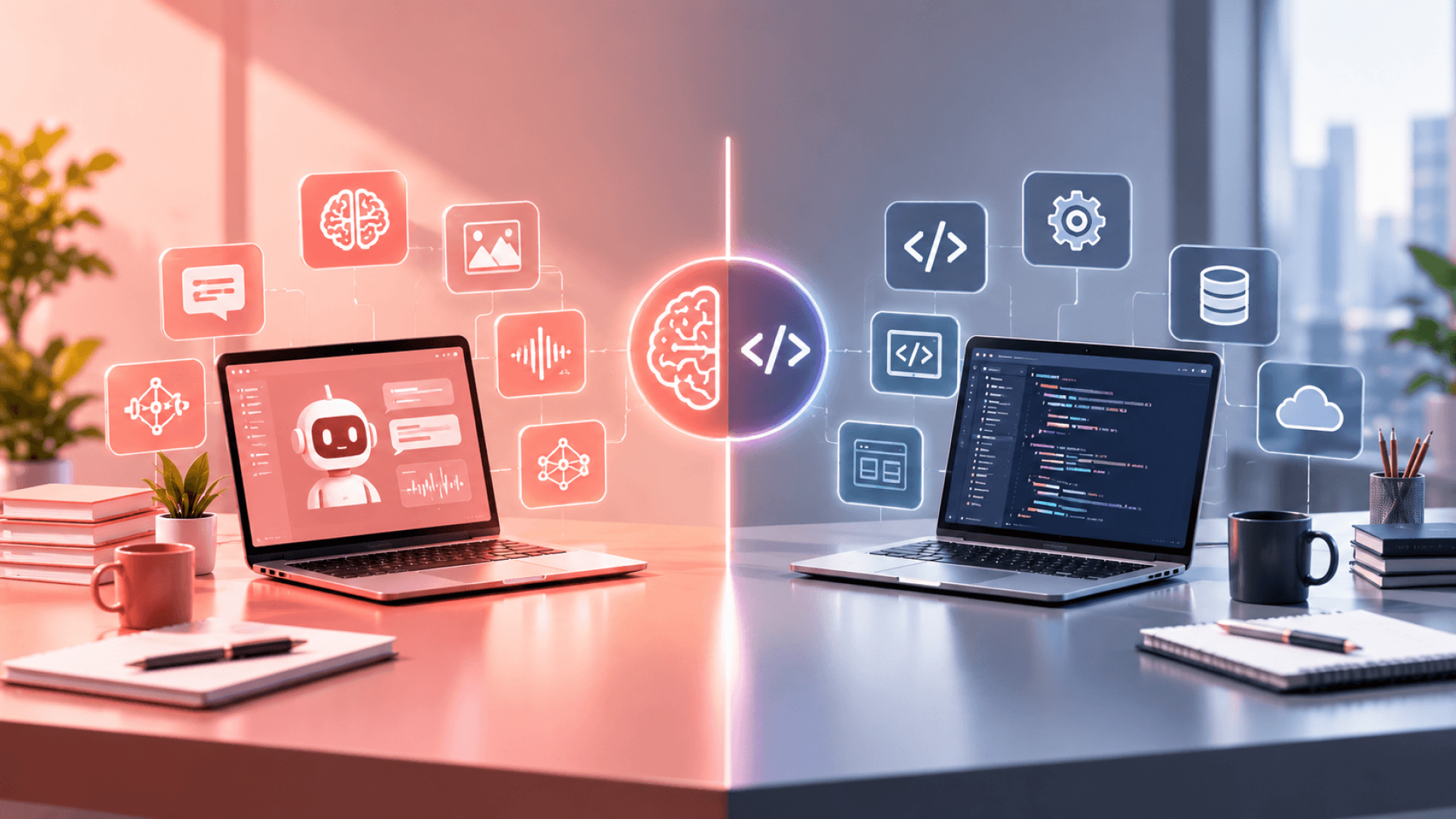
A software development company writes clear rules that give predictable outputs. An AI development company builds systems whose behavior comes from data and models. It then measures and controls that behavior over time.
The first ships features. The second ships features plus the tools to keep an unpredictable system reliable.
Gartner puts the problem plainly in its 2026 Market Guide for AI Evaluation and Observability Platforms. Nondeterminism in generative and agentic AI makes reliability hard to measure and improve. Traditional pass or fail testing was not built for that.
Core Differences at a Glance
Dimension
Software Development Company
AI Development Company
Logic
Explicit rules written by engineers
Patterns learned from data
Outputs
Deterministic: same input, same output
Probabilistic: outputs vary and are scored
Testing
Pass or fail against a spec
Accuracy, relevance, and safety scored across test sets
Role of data
Input the system processes
Core asset that shapes behavior
After launch
Bug fixes and feature releases
Monitoring for drift, re-evaluation, and retraining
Team
Frontend, backend, QA, and DevOps engineers
Adds ML engineers, data engineers, and evaluation specialists
Why Does Testing Work Differently for AI Systems?
AI output can be wrong in ways a status code never shows. A reply can load fine and still state something false. So AI teams test with scored datasets and keep scoring in production.
Gartner expects use of AI evaluation platforms to grow from 18% of software teams in 2025 to 60% by 2028. The lesson: testing AI output is becoming a standard part of the stack. A partner without an evaluation habit will ship systems nobody can prove are accurate.
Ask any vendor one question: "How will you know if accuracy drops next month?" A software shop often answers with uptime monitoring. An AI shop answers with an evaluation suite, a threshold, and an alert.
What Does an AI Development Company Actually Do?
An AI development company turns models into product features you can trust. The work covers model choice, retrieval, agents, testing, cost control, and governance. It also includes the unglamorous part: cleaning and connecting data.
In practice, that means RAG systems that ground answers in your documents. It means AI agent development for workflows that take actions.
It also covers generative AI development for features that write, summarize, or answer questions. Each needs evaluation and cost tracking that ordinary software does not.
A good software firm is still the right partner for most app work. Architecture, APIs, frontends, and DevOps are real skills. Many AI projects fail on these basics, not on the model.
Software firms are also adopting AI in their own delivery. HFS found agents handling code generation, testing, and release work at 40% to 70% autonomy in some production programs. That makes them faster at building software.
But faster coding is not AI product expertise. A team that uses AI assistants daily may never have evaluated a model, tuned retrieval, or tracked inference cost. Judge the product they have shipped, not the tools they use.
When Should You Choose Each Type of Partner?
Choose based on where your product's value comes from. If users pay for the AI's judgment, you need AI expertise at the core. If AI is one feature among many, a strong software firm may be enough.
Your Situation
Choose
Why
The product's core value depends on model output
AI development company
Accuracy and drift become product risks
You need RAG, agents, or LLM integration
AI development company
Retrieval, evaluation, and cost control are specialist work
You need a web or mobile app with no model behavior
Software development company
Deterministic engineering is the whole job
You want one AI feature in a mostly standard app
Either, with an evaluation plan in the contract
The feature still needs scoring after launch
You have an in-house team but lack AI depth
AI development company for a scoped build plus handover
These are vendor-published figures, so treat them as a market signal, not a quote. Model usage continues after launch, so budget for it as a running cost. Our full breakdown of AI development cost covers what moves the number.
How Long Does an AI Project Take Compared With Software?
AI timelines stretch when data needs work or legacy systems sit in the way. Published examples range from about three months to 18 months.
Type
Published Example
Duration
First Value
Scoped AI program
Distyl AI says it scopes to production within three months, per Plank Research
About 3 months
One workflow in production
GenAI platform build
Neoteric built a GenAI SaaS platform, per F22 Labs
8 months
A complete product
AI-led legacy modernization
Ascendion modernized a 40-year-old wealth platform for a US bank, per HFS
18 months
Launch at 45% lower cost
The gap between a prototype and a production system is where most AI budgets break. We explain that gap in our guide to moving AI from prototype to production.
Which Compliance Rules Change When You Add AI?
AI brings rules that ordinary software does not trigger. The EU AI Act labels some uses as high-risk.
Lawmakers agreed to push those Annex III duties to 2 December 2027, per law firm Gibson Dunn. The delay moves the date, not the duty.
Region
Requirements
What Your Partner Should Prove
European Union
AI Act high-risk duties for uses such as credit scoring and hiring
A risk classification for each AI feature
United Kingdom
Sector regulators such as the FCA apply existing rules to AI outputs
Audit trails that explain each automated decision
United States
Sector rules such as HIPAA cover health data used by AI features
Signed data terms and clear handling of sensitive data
Any market
ISO/IEC 42001 defines an AI management system standard
A certificate or a dated plan to get one
Governance is also an engineering problem. Gartner predicts that by 2030, 50% of AI agent deployment failures will stem from weak runtime enforcement of governance rules.
How Do You Evaluate a Partner's Real AI Capability?
Ask for evidence that the partner has run AI in production and measured it. Slides about models prove nothing.
Criterion
What Good Looks Like
Red Flag
Production evidence
Named or referenceable AI systems running with real users
Only prototypes and demos
Evaluation discipline
Scored test sets before launch and ongoing scoring after
Testing described as "we try it and it works"
Data engineering
A plan for data access, cleaning, and permissions
Data treated as the client's problem
Cost instrumentation
Cost tracked per request and per feature
No estimate of monthly model spend
Governance
Guardrails, audit logs, and human review where decisions matter
Governance handled only in the contract
Knowledge transfer
Documentation and handover built into the plan
Your team cannot run the system without them
Plan to build the team yourself? Our guide on how to hire an AI developer covers the roles and interview questions.
What Goes Wrong When a Software Firm Takes On AI Work?
The usual failure is not bad code. It is a system that works in the demo and degrades quietly in production.
Challenge
Impact
How to Defuse It
Messy or inaccessible data
Named by 61% of surveyed leaders as a top GenAI challenge
Run a data readiness check before scoping
No evaluation suite
Accuracy drops go unnoticed
Make scored test sets a contract deliverable
Surprise running costs
Gartner lists escalating costs among the top reasons agentic projects get canceled
Require a monthly model spend forecast
Weak runtime governance
Gartner links future agent failures to poor enforcement
Ask to see guardrails working on live traffic
No drift monitoring
Quality decays as data and users change
Set accuracy thresholds with automatic alerts
What Is AI-Native Software Development?
AI-native software development treats AI as core architecture from day one, not a feature added later. The evaluation, cost tracking, and governance layers are designed alongside the application. It combines the discipline of a software firm with the measurement habits of an AI firm.
This is the model to look for if AI is central to your product. It avoids the rework of bolting a model onto a system that was never built to measure it.
How Cypherox Approaches AI-Native Development
Cypherox is an AI development company, so read this section as a vendor's view. We did not write this guide to rank anyone.
We scope AI work around the checks in this guide. Each build starts with a data readiness review, a scored evaluation set, and a cost forecast per feature. The application layer is built with the same rigor as any software project.
Frequently Asked Questions
Can a software development company build AI products?
Yes, if it has shipped AI systems into production and measured them. Many software firms use AI coding tools without that experience. Ask for a live AI system, its evaluation method, and its monthly model cost before you decide.
Do I need an AI development company for RAG or agents?
Usually, yes. RAG and agents need retrieval design, evaluation, cost tracking, and governance that standard software projects skip. A software firm can succeed if it has shipped these systems before and can show how it measured accuracy.
How much more does AI development cost than software development?
AI adds evaluation, monitoring, and ongoing model costs on top of the build. Published vendor data puts generative AI minimum engagements at $10,000 to more than $100,000. Ask for a monthly model spend forecast as well as the build quote.
What is the difference between AI development and ML development?
ML development trains models on your data for tasks such as prediction or classification. AI development is broader and includes building products on existing large language models with retrieval, agents, and evaluation. Many AI projects today involve little model training.
Conclusion
The real question is not which label a vendor uses. It is whether they can prove an AI system stays accurate, safe, and affordable after launch. Use the scorecard above, ask for production evidence, and put evaluation into the contract.
About the Author
Vipinraj Nair
Founder & CEO
Vipinraj Nair is the Founder and CEO of Cypherox Technologies, which he started in 2015. He leads the company's work across custom software, web and mobile development, and AI solutions for startups, SMEs, and enterprises worldwide. He writes on technology trends, custom development, and how businesses put emerging tech to practical use.